Skincare and Menstruation: Why Your Skin “Goes Crazy”


If you have ever felt that your skin lives its own life depending on the time of the month, it is not an exaggeration. Maybe you get breakouts exactly a week before your period. Maybe there are days when your skin looks flawless and then, suddenly, it becomes dull, dry or sensitive. This cyclical change is not random and it is not just a “hormonal mood” that you happen to notice. The skin is an organ that is deeply influenced by hormonal fluctuations, far more than you might imagine.
Why Does Your Skin “Go Crazy”?
Every month, your body goes through a complex sequence of changes that prepare it for a possible pregnancy. Each hormone involved plays a specific role, and the skin is one of the first “grounds” where these changes show up. Regardless of your skin type, there is a strong chance that at certain points in your cycle you notice increased sensitivity, excess sebum, more congested pores, severe dryness or even deep, painful breakouts.
To understand why your skin reacts like this, we need to look at the three main hormones that dictate its behaviour during the menstrual cycle: oestrogen, progesterone and testosterone. Each of them affects the skin through different mechanisms, but together they create a very dynamic picture.
Estrogen – Your Skin’s Ally
Estrogen is probably the most “friendly” hormone when it comes to how your skin looks. When its levels are high, the skin becomes brighter, better hydrated and more elastic. Estrogen stimulates collagen production, improves blood flow to the skin and supports the epidermis’ natural ability to regenerate.
On the days when oestrogen is at an optimal level, your complexion naturally appears firmer and healthier. This is why many women notice that around ovulation their skin seems at its most radiant. It is essentially the moment when your hormones are working in your favour.
Progesterone – The Hormone with Two Faces
Progesterone, on the other hand, is much more unpredictable. Its levels rise significantly after ovulation, and this can lead to less welcome changes. Progesterone stimulates the sebaceous glands, which means more natural oil.
In addition to boosting oil production, progesterone also causes mild water retention in the tissues, which can make the skin look slightly puffy. This combination – more sebum and less space inside the pores – encourages blockages and, as a result, breakouts.
This is why many women experience more visible blackheads, enlarged pores and painful acne about a week before their period. It is not a coincidence: this is exactly when progesterone peaks.
Testosterone – The Hidden Trigger Behind Acne
Contrary to what you might think, testosterone does not change dramatically throughout the menstrual cycle. Its level remains relatively constant, but when oestrogen and progesterone drop (in the premenstrual days and during bleeding), its influence becomes stronger.
Testosterone stimulates sebum production and, when it “dominates” in the absence of oestrogen and progesterone, the sebum becomes thicker and more viscous. This explains those painful spots and deep inflammation that tend to appear on the chin and jawline – areas rich in sebaceous glands that are highly sensitive to androgens.
Why Do Spots Show Up Exactly When You Need Them Least?
You have probably been there: an event, a photo shoot, an important meeting is coming up, and two days before, a hard, deep, red and tender spot appears – usually on your chin.
This is the classic hormonal breakout, and the area is not random. The lower face, including the jawline and neck, has a high concentration of hormone receptors. When progesterone and testosterone take over, these sebaceous glands respond quickly, triggering inflammation.
A 2014 NIH study showed that around 40% of adult women notice a worsening of acne in the premenstrual week. Inflammation increases, pores clog more easily and the skin heals more slowly. In other words, your body sets the ideal stage for acne to appear.
Heightened Sensitivity During Your Period
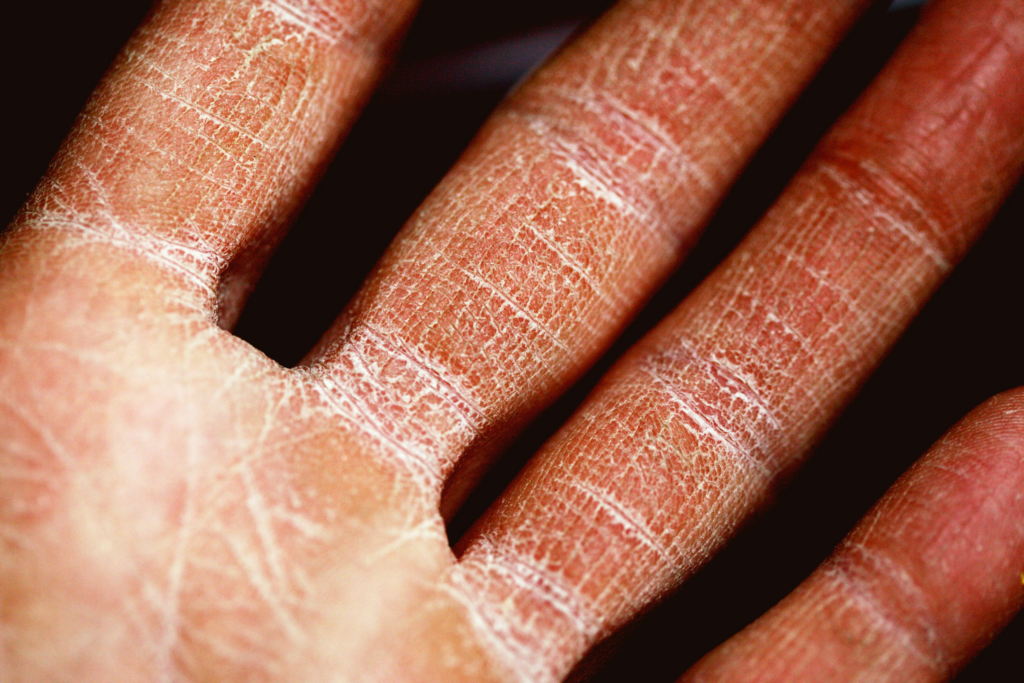
During menstruation itself, oestrogen and progesterone levels are extremely low. The skin becomes more sensitive, drier, more easily irritated and loses some of its ability to retain moisture effectively.
The skin’s protective barrier is more vulnerable, and any pre-existing inflammation – dermatitis, redness, acne – tends to flare.
This is one of the reasons why many women feel that their usual products “stop working” during this time, or even start to irritate the skin.
Why Sync Your Skincare with Your Menstrual Cycle
Because your skin responds directly to your hormones, your skincare routine cannot be the same every week. Using the exact same products every day, regardless of context, is like wearing the same jacket in July and in January – it simply does not fit, and in many situations it works against you.
Instead of reacting only when a spot appears, you can anticipate change and prevent problems with a few simple adjustments at each stage of the cycle.
Synchronising your skincare routine with your monthly cycle means being proactive, not reactive.
What You Can Do Beyond Products
Keep a skin diary.
Note down day 1 of your cycle and pay attention to how your skin feels on key days: 7, 14, 21, 25. Within just two months you will start to see clear patterns.
Look after your diet in the premenstrual phase.
Reducing refined sugar and dairy can help prevent inflammation from escalating.
Stay properly hydrated.
Dehydration prompts the skin to produce even more sebum, especially in the luteal phase.
Keep your routine flexible, not rigid.
Your skin has different needs depending on the day of your cycle, so flexibility is essential.
Self-awareness and Gratitude
Understanding how your menstrual cycle affects your skin is not an extra complication; it is an act of self-knowledge. It is a way of listening to your body’s signals, supporting it and working with it, not against it.
Do not chase perfection. Look for progress, balance and conscious adaptation.